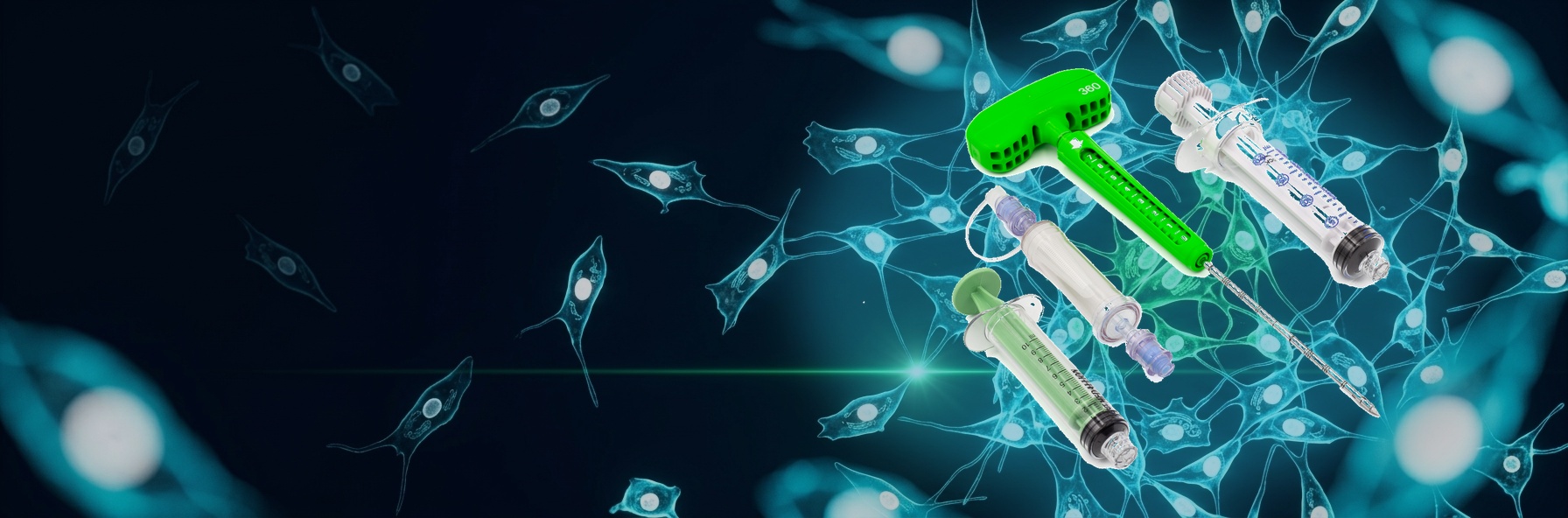
02 / Bone Marrow Aspiration
The patient's own biology, put to work.
A point-of-care aspiration system built on one premise: what matters in a marrow graft is not total cell count but the number of true early-stage stem cells, measured as colony-forming unit-fibroblast (CFU-f). In clinical work on non-union and osteonecrosis, CFU-f content was the only measured variable that reached statistical significance. Not total nucleated cells. Not platelets.
The device is designed to protect that fraction. A closed and sealed distal tip means 100% of the harvest is lateral, drawn perpendicular to the channel the cannula creates. An open-ended device pulls through the tip, where peripheral blood dominates. A micrometric gear retracts the cannula 5 mm with each 360° rotation, so every 0.5–1 mL pull comes from a fresh marrow site without repositioning the device. You get many small high-quality aspirates instead of one large diluted one, consistent with published work showing that small-volume, small-syringe technique yields greater CFU-f.
It is a single-step, centrifuge-free device: no processing time, no machinery loan, no dedicated staff, and no reason to leave the sterile field. The concentrate is ready to use at the point of care. Per manufacturer data, roughly 40% more cells survive than in centrifuge-based systems.
Centrifuge-based concentration discards roughly 85% of the aspirate and leaves an estimated 40% of stem cells behind in the discarded red cell fraction. That includes dense, actively cycling anti-inflammatory progenitors, which always sediment with the red cells. Centrifugation also cannot distinguish marrow-derived nucleated cells from peripheral blood ones, since both share the same density. In older patients, that concentrates inflammatory macrophages and neutrophils along with everything else.
The relevance is age-dependent. Circulating platelet and white cell counts hold up over a lifetime, but the body's ability to mobilize marrow stem cells to a site of trauma declines substantially with age. In older or healing-impaired patients, the vasculogenic signal from platelets alone is often not enough to complete the cascade. The concentrated aspirate can be combined with a bone graft substitute to carry those cells to the defect and hold them there.
40%
More cells survive versus centrifuge-based systems, per manufacturer data
100%
Lateral harvest through a closed, sealed distal tip
5 mm
Cannula retraction per 360° rotation, fresh marrow site each pass
Mechanism: selective lateral marrow aspiration · centrifuge-free, CFU-f preserving